Emergency Tree Removal
A tree down in Clarksville, day or night
Storm damage and emergency removals off houses, structures, fences and vehicles, answered around the clock, with the crane and spider lift already on the truck.
Chapter 01
The first ten minutes
The most important thing to get right when a tree comes down is what nobody does in the first ten minutes. If any part of the tree, or any branch, is touching or even near a power line, that is the utility company's call and nobody else's, full stop. Nobody in the household, and nobody Charlie sends out, approaches a downed line or a tree that's leaning on one. Get people and pets clear of the area underneath the span and call the utility before calling anyone else.
The second instinct to fight is reaching for a chainsaw. A tree that's already fallen is rarely sitting the way it looks like it's sitting: it can be under tension from a bent limb, resting its full weight on a fence or a roofline that's one wrong cut from letting go, or still rooted enough on one side to roll. Leave the chainsaw in the garage and let a crew that does this daily make the call on how the tree is actually loaded before anything gets cut.
The tree on the ground usually isn't the only problem either. A storm strong enough to drop one tree has usually cracked or loosened limbs in the trees still standing around it, the kind of overhead hazard arborists call a widow maker because it gives no warning before it lets go. Walk the yard with that in mind after any storm, keep everyone out from directly underneath the standing trees as well as the fallen one, and treat the whole area as unsettled until a crew has had eyes on it.
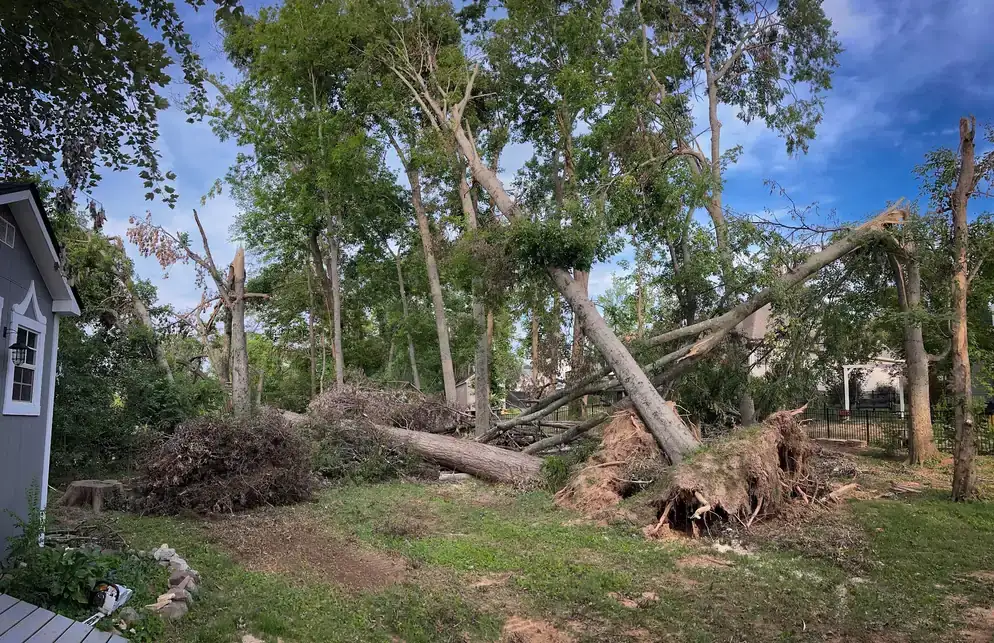
Several uprooted trees down across a residential back yard in Clarksville after a storm
What happens when you call at two in the morning
Clean Cut Charlie is genuinely open 24 hours, every day of the week, which is a different thing from a lot of companies that advertise emergency service and then send an answering machine after dark. A call in the middle of the night gets answered, and the crew that comes out treats the first visit as a make-safe, not a full removal: getting weight off a compromised structure, securing whatever opening has been torn into a roof or a wall, and stopping anything that's still moving from doing more damage overnight.
The full removal, cutting the tree down to ground level, hauling debris, and grinding a stump if that's part of the job, usually happens in daylight. That's not a delay tactic, it's the safer order of operations: rigging a crane pick or running a spider lift into a yard is a different level of risk in the dark than it is in the morning, once the immediate danger to the house or the people in it has already been dealt with.
None of that works if the equipment shows up separately from the crew. The crane, the tracked spider lift, and the chipper ride with the trucks, and the New Holland and the Brandit gear that handle the heavier pulls and drags are already loaded, so a call at two in the morning isn't waiting on someone to go find a machine. The climbers carry the same Stihl saws and Petzl and Timberline rigging gear they'd use on a scheduled job, because a storm call still deserves a properly rigged cut, not a rushed one.
Chapter 03
Storm damage and the insurance claim
This crew has handled hundreds of emergency removals off houses, structures, fences, and vehicles over the years, and a real share of that work gets filed as an insurance claim rather than paid out of pocket. Photographs get taken before anything is moved, because an adjuster needs to see the tree the way it actually landed, not a yard that's already been cleared. That documentation step is part of the job on storm calls, not an extra service tacked on afterward.
One of Charlie's Google reviewers, Mandy Beach, wrote that having what she called an insurance claims specialist on the crew was a real help in getting her storm damage covered, and that the company didn't ask her for a deposit or a signed contract before starting the work, unlike some of the other companies she'd called. That's the same policy on every emergency job: no deposit and no contract required up front, because a family staring at a tree through their living room ceiling shouldn't have to negotiate paperwork before someone shows up to deal with it.
Clean Cut Charlie runs 24 hours a day out of Clarksville, storm calls included. Call (931) 378-7104 any time.